Québec, Québec
Rope stanchions in Quebec City
Rope stanchions, velvet ropes, sign stands and belt posts to buy or to rent, delivered across Québec and the municipalities around it.
What these rooms order
Rope, mostly — and it is not only for the look.
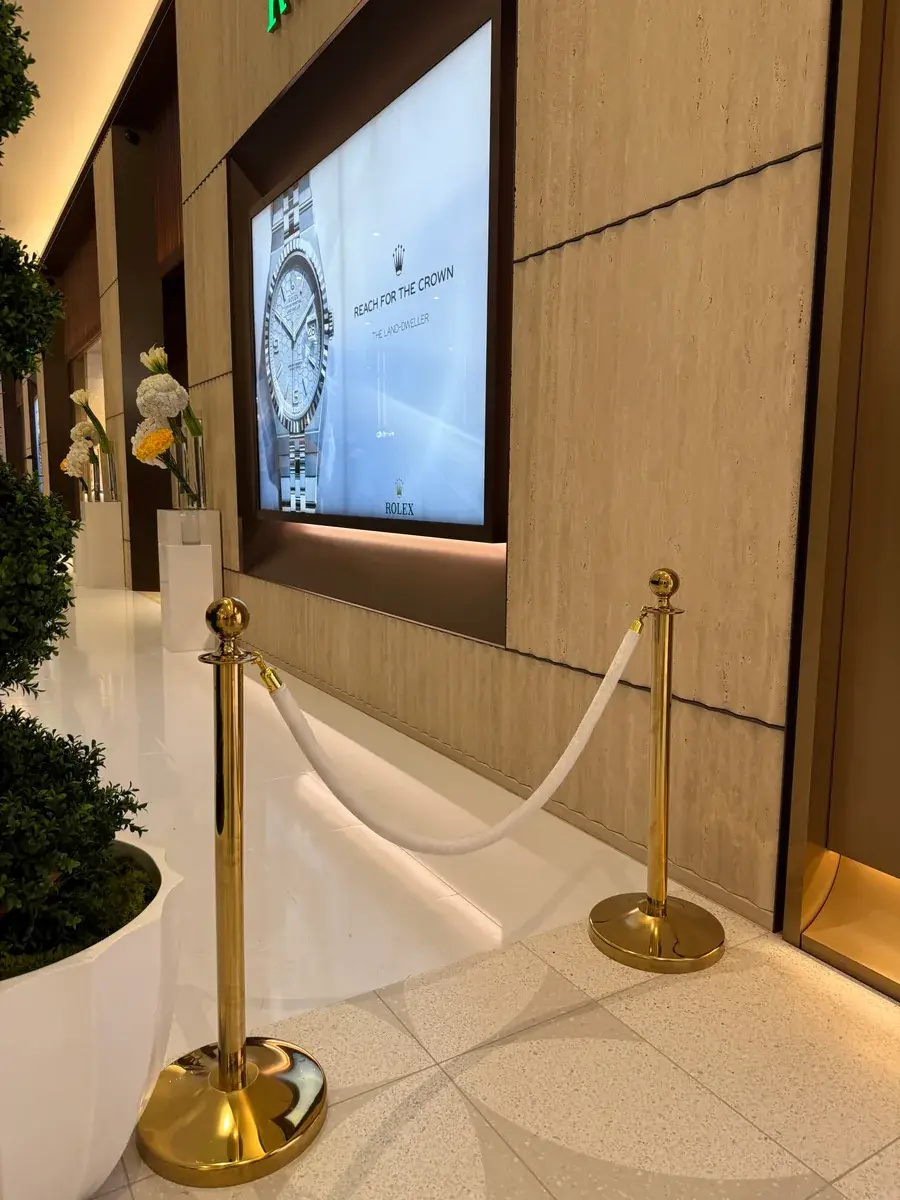
A retractable belt is a mechanism: it clips to the next post, it pulls taut, and it puts a load into whatever the base is standing on. A rope hangs. It carries almost no tension between posts, so the posts stay where they were put rather than being drawn towards each other over a long afternoon, and on a floor that must not be scuffed that difference is the whole argument.
Rope posts with weighted bases
Held down by mass rather than by fixing. Nothing enters the floor and nothing has to be made good afterwards.
Bases with a rubber ring
The part that touches stone or timber. A bare metal foot marks a polished floor within an afternoon of being nudged.
Frames that stand, not fix
Free-standing sign holders rather than anything wall-mounted, because in these buildings the wall is usually the exhibit.
Where we deliver
The old city, and the ring around it.
Deliveries cover the city and its surrounding municipalities. Inside the walls the access is the interesting part rather than the distance: narrow streets, restricted vehicle hours and buildings whose only opening is a door that was made for people. An order for the old town is packed to be carried.
- Québec
- Lévis
- Sainte-Foy
- Beauport
- Charlesbourg
- L’Ancienne-Lorette
- Saint-Augustin
- Wendake
Orders go into rooms that were not designed around us:
- the convention centre on the upper town
- the historic hotels above the river
- the fortifications, the citadel and the museums inside the walls
- the concert halls and the theatres
- the university campus at Sainte-Foy
- the airport terminal west of the city
Tell us the street and the door rather than the postal address. Inside the walls that is the part that decides whether an order arrives in one trip.
Working on a floor you cannot repair
Weight it, ring it, and never drag it.
Three habits protect an old floor and none of them costs anything. Choose a base that holds by weight rather than a fixing, so nothing goes into the surface. Make sure whatever touches the floor is rubber rather than metal, because the mark a bare foot leaves in stone does not polish out. And carry the posts rather than sliding them, which is where almost all of the damage in these rooms is actually done.
Nothing fixed down
No sockets, no flanges, no adhesive. In a protected building those are a conversation with the owner, not a specification choice.
Rubber where it lands
A ring on the base of every post. It is a small part and it is the difference between a room returned as found and a repair.
Carry, do not slide
A cart to the door and hands from there. Dragging a weighted base across stone is the one mistake these floors do not forgive.
Worth asking
What a heritage room asks before anything comes in.
- Why rope rather than a retractable belt?
- Because a belt pulls and a rope hangs. A tensioned belt draws its two posts towards each other all day, which on a floor that must not be scuffed means the bases move, and moving bases are what leave marks. A rope puts almost nothing into the posts either side of it.
- Can anything be fixed to the floor?
- We would assume not, and design the layout so nothing has to be. Sockets and floor flanges are permanent alterations to a protected surface, which makes them a conversation with the building owner rather than a line in a specification. Weighted bases do the same job with nothing left behind.
- What stops the bases marking stone?
- A rubber ring on the underside of every base, and a rule about carrying rather than sliding them. Almost all the damage done to a floor like that happens during the setup rather than the event, and it is done by moving a heavy base the easy way.
- How does an order get into the old town?
- Usually carried. Streets inside the walls are narrow, vehicle access is restricted by hour, and several of the buildings have no dock of any kind. We pack an order for that quarter to be handled rather than wheeled, so tell us the door rather than the address.
- Can the printed wording be in French?
- Yes, and it is produced from the copy you send. Anything printed is made for the order rather than picked from stock, so the wording is settled before production begins and the printed items travel with the rest of the equipment.
Ask for a quote
Tell us which room in Quebec City and which door.
Add what you need with the Buy or Rent button on each product, then open the order and say how many and where. You get a written quote back with the options laid out. Delivery, setup and collection are quoted on their own lines, so you can take them or leave them.